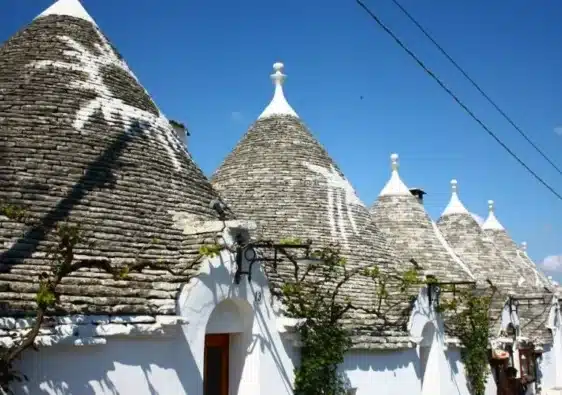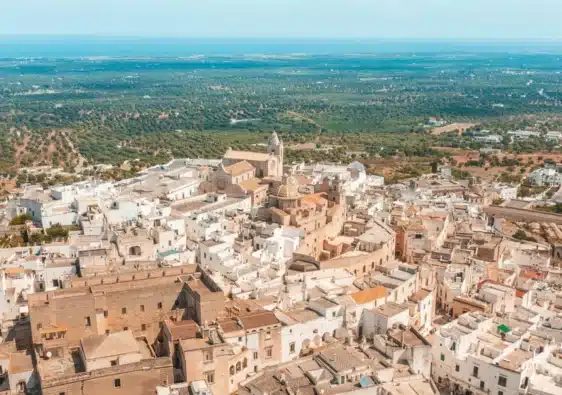

A little over a kilometre from the whitewashed streets of Ceglie Messapica, a flight of thirteen stone steps drops down into the ground and into a completely different Puglia — cool, dark, and shaped over millennia by water rather than by hand. This is Grotte di Montevicoli, a small karst cave system tucked into the countryside of the Valle d’Itria, and one of the region’s more overlooked natural attractions, despite carrying a genuinely striking mix of geology, ancient history and local Christmas tradition packed into a walk of barely 100 metres. Most visitors to this part of Puglia spend their time above ground, among the trulli and whitewashed alleys the valley is famous for — Montevicoli is a rare chance to see what’s underneath it all instead.
Grotte di Montevicoli: The Hidden Caves Beneath Ceglie Messapica
The caves sit in the district of the same name, about 1.5 kilometres from the town centre, in the same rolling, olive-covered landscape that surrounds Ceglie Messapica on every side. They’re not a major tourist draw on the scale of the Grotte di Castellana further north, and that’s precisely the appeal — a quiet, low-key detour for anyone already exploring this corner of the Valle d’Itria who wants to see a side of the Murge landscape that sits beneath the surface rather than on top of it.

🕳️ How the Caves Were Discovered
The caves were found more or less by accident in the early 1960s, uncovered during work to rearrange a dry stone wall on the land above — one of those small, unglamorous farming tasks that occasionally opens onto something far bigger underground. Once discovered, Grotte di Montevicoli became a genuinely popular local attraction, drawing steady visitor numbers right through until 1996, when the site was closed to the public.
What followed was a long, uneven stretch of closures and short reopenings. The caves briefly reopened in 2005, when a nativity scene was installed inside to revive the site’s old Christmas tradition, but access remained inconsistent in the years after. The turning point came on 30 December 2014, when the municipal administration of Ceglie Messapica purchased the land directly above the caves, finally bringing the site under stable local management. Using European funding from the Greece–Italy Cooperation Program 2007–2013, the town carried out restoration and safety works throughout late 2015, upgrading and securing the roughly 100-metre visitor route through the cave. The caves reopened to the public again on 19 December 2015, and have operated on a more formal, if still occasionally limited, schedule since — a genuinely local story of a small natural site being rescued from years of neglect through municipal investment and EU cooperation funding rather than private tourism development.
💡 Pro tip: given this history of intermittent openings, treat Grotte di Montevicoli as a “check before you go” attraction rather than a guaranteed stop — even in more recent years, visitors have occasionally found the site closed without much notice. Confirming opening status directly with the Ceglie Messapica tourist office before making the trip out is worth the extra few minutes.

⛏️ An Ancient Cult Site Beneath the Farmland
Beyond the geology, Grotte di Montevicoli carries a genuine thread of ancient history. Epigraphic inscriptions found near the cave entrance suggest the site held religious significance long before anyone thought to call it a tourist attraction. In 1879, an architectural fragment recovered from the cave’s forward chamber was found to carry a dedication to Aphrodite — using a Greek-derived form of her name — made by a woman named Theotoridda. That fragment is now preserved in the Museo Provinciale di Brindisi, and it’s one of the more tangible pieces of evidence that this small karst cavity, sitting quietly in farmland outside a Messapian-founded town, was once treated as a place of worship.
It’s a detail easy to miss walking through the cave today, but worth carrying with you — the same cool, echoing chamber that modern visitors walk through with a guide once drew people down those same steps for reasons entirely different from tourism, at a time when this corner of Puglia was still Messapian territory rather than the Valle d’Itria we know now.

🪨 What You’ll See Inside
Access to the caves is through a gated entrance that protects the opening from the surface. From there, thirteen stone steps lead down into the first chamber, and about six metres in, the first stalagmites and columns begin to appear — the earliest signs of the mineral formations that define the rest of the visit. The full walking route runs approximately 100 metres (some local sources describe it as a half-kilometre round trip including the approach), taking around an hour at an easy, unhurried pace.
Inside, the caves hold a genuinely striking concentration of stalactites, stalagmites and columns, in places dense enough to have fused into shapes that look closer to natural sculpture than typical cave formations. To the right of the main path, a small chamber holds a shallow pool fed by dripping water — a quiet, still spot that gives a sense of the slow mineral processes still shaping the cave today, drop by drop, the same way they have for thousands of years.
💡 Pro tip: the cave interior sits at a fairly constant temperature of around 17°C year-round, noticeably cooler than the surface in summer and warmer than a winter morning outside — dress in light layers so you can adjust once you’re below ground.
🎄 The Christmas Nativity Tradition
For much of its history as a public attraction, Grotte di Montevicoli has been tied to a specific local tradition: an artistic presepe — nativity scene — set up in the final chamber of the cave every Christmas season. This tradition ran continuously from the caves’ original opening year right through to the 1996 closure, and it’s part of what the 2005 reopening was specifically designed to revive.
During the Christmas period, traditional zampognari bagpipers play at the cave entrance to welcome visitors, adding a genuinely atmospheric, old-fashioned touch to the descent underground. On Christmas Eve itself, it’s possible to attend Midnight Mass inside the cave — a striking setting for the service, and one of the more unusual Christmas traditions anywhere in the Valle d’Itria. If you’re already planning a trip around Christmas in Puglia, this is a genuinely distinctive addition to a season built around living nativities and illuminated town centres.
🚗 How to Get to Grotte di Montevicoli
The caves are located at Via delle Grotte / Contrada Montevicoli, 72013 Ceglie Messapica (BR), about 1.5 kilometres from the town center. A car is the most practical way to reach the site, since it sits out in the surrounding farmland rather than within walking distance of the old town.
⭐ Rent Your Car
Search rental deals with Rentalcars — easy and hassle-free.
✔ Instant confirmation
The site is managed by the Comune di Ceglie Messapica, and guided visits are generally required rather than free self-directed exploration — the local tourism office (IAT Ceglie Messapica) is the best point of contact for current opening days, guided tour times, and group excursion schedules, including occasional themed events such as geology-focused walks organized in partnership with local cooperatives.
💡 Pro tip: wear proper shoes with a non-slip sole — the stone steps and cave floor can be damp underfoot, and this isn’t a site to attempt in sandals or smooth-soled shoes. Bringing a small bottle of water is also worth it, even for a visit this short, since the walk down and back up the steps is enough to work up a bit of a thirst in the enclosed air.

🗺️ Nearby Places Worth Visiting
- Ceglie Messapica — the food capital of the Valle d’Itria, just 1.5km away, with a Norman-Angevin Ducal Castle, a labyrinth of whitewashed alleys, and the best restaurant scene in the Brindisi province
- Valle d’Itria — the wider valley Ceglie Messapica sits at the southern edge of, covering every town and the best driving routes between them
- Locorotondo, Martina Franca and Cisternino — the valley’s other headline towns, each roughly 20–25 minutes away and easy to combine with a Ceglie Messapica stop
- Grotte di Castellana — Puglia’s most famous cave system, further north, worth comparing if you want to see the difference between a major show cave and a small, local one like Montevicoli
⭐ Book tours & experiences
Visit Get Your Guide or Viator for unforgettable activities, skip-the-line tickets, and local adventures.
✔ Instant confirmation
✔ Small groups
Plan Your Visit to Grotte di Montevicoli
Grotte di Montevicoli isn’t going to compete with Puglia’s headline attractions for scale, and it isn’t trying to — what it offers instead is a small, genuinely local window into the karst landscape that shapes so much of this part of the Murge, layered with a Christmas tradition and an ancient religious history that most visitors to the Valle d’Itria never hear about. An hour underground, thirteen steps down from an olive grove, is a different kind of Puglia experience from a piazza or a beach, and it’s worth the detour if you’re already based nearby.
Confirm opening times with the local tourism office before you go, sort your car rental, and pair the visit with a stop in Ceglie Messapica itself — between the castle, the old town, and the best restaurant scene in the valley, it’s an easy full afternoon built around one quiet cave.
FAQs
Yes, especially if you’re already spending time in Ceglie Messapica or the Valle d’Itria — it’s a small but genuinely interesting karst cave with ancient religious history, striking stalactite and stalagmite formations, and a distinctive Christmas nativity tradition.
Opening has historically been inconsistent, with the most reliable period being the Christmas season when the nativity scene is installed. Confirm current opening days and guided tour times directly with the Ceglie Messapica tourist office before visiting.
The visitor route is around 100 metres and typically takes about an hour at a relaxed pace, including time to see the stalactite formations and the small dripping-water pool.
The caves were discovered in the early 1960s during dry stone wall repairs, visited regularly until a 1996 closure, briefly reopened in 2005, and reopened again more formally in December 2015 following municipal restoration work funded through a Greece-Italy EU cooperation program. Archaeological finds, including a 19th-century inscription dedicated to Aphrodite, suggest the site held religious significance in antiquity.
Yes — the caves have a long-standing tradition of installing an artistic nativity scene each Christmas season, with traditional zampognari bagpipers playing at the entrance and the possibility of attending Midnight Mass inside the cave on Christmas Eve.
✅ Book your flights: Find the best airfare deals with Skyscanner or Aviasales.
🏨 Secure your stay: Compare hotel rates easily on Booking.com or Hotellook.
🛡️ Don’t forget travel insurance: Stay protected with Ekta or VisitorsCoverage — reliable and flexible options.
🎟️ Book tours & experiences: I always use Get Your Guide or Viator for unforgettable activities, skip-the-line tickets, and local adventures.
🚗 Need a car? Search rental deals with Rentalcars and DiscoverCars — easy and hassle-free.
🚕 Taxi or transfer? Pre-book your ride with WelcomePickups or GetTransfer for a smooth arrival.
🚆 Traveling by train or bus? Check schedules and book tickets in advance with Omio.