

The car park at Porto Selvaggio is unremarkable. A gravel clearing, pine trees at the edges, a wooden signboard with a trail map. You walk in from the road. The forest closes around you — dense Aleppo pine, wild olive, eucalyptus, macchia mediterranea — and the sea immediately disappears. There’s no sound of water yet, no sight of it. Just the forest floor, the filtered light, the smell of pine resin.
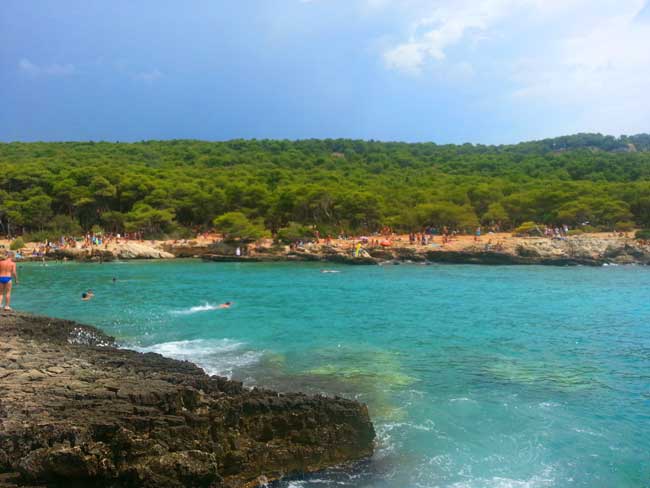
Ten minutes later the trees thin, the path descends through exposed limestone, and the Ionian appears below: a rocky cove between two watchtowers, the water an extraordinary shade of green-blue, utterly clear to the bottom. No beach clubs. No sunbeds. No facilities. Just the rock and the water and the forest that got you here.
🌿 The Walk That Earns the Beach
This is Porto Selvaggio, Puglia — wild port, as the name translates. A 1,000-hectare regional nature reserve on the western Ionian coast of Salento, between Porto Cesareo and Gallipoli, managed specifically to remain exactly as it is. No development. No road to the water. No café at the cove.
The walk through the forest is the price of admission. It’s a good price.
📅 Best Time to Visit Porto Selvaggio
| Season | Conditions | Verdict |
|---|---|---|
| April – May | Mild, forest vivid, sea still cool. No crowds. | ✅✅ Outstanding for walking and photography |
| June | Warm, sea swimmable (22–24°C), manageable visitors. | ✅✅ Best overall window |
| July – August | Hot, peak season, busy. Forest walk at 9am only. | ⚠️ Arrive before 9am — car park fills fast |
| September | Sea warmest (26–27°C), crowds thin sharply. | ✅✅ Excellent — the best swimming month |
| October – November | Quiet, mushrooms in the forest, birdwatching peak. | ✅ Excellent for nature |
| December – March | Very quiet, birdwatching at Palude del Capitano. | ✅ For the dedicated naturalist |
June and September are the best months for combining the forest walk with swimming. September in particular — the sea is at its annual warmest, the summer crowds have gone, and the forest is still green and fragrant.
💡 In July and August, the car park fills by 9am on weekends. Arrive before 8:30am or accept a long walk from roadside parking on the SP87. Weekday mornings are significantly more manageable. The cove itself, once you’re there, feels wild regardless of season — the walk filters the crowds naturally.
🌲 The Reserve — What Porto Selvaggio Actually Is
The Parco Naturale Regionale di Porto Selvaggio e Palude del Capitano was established in 2006, incorporating the older Porto Selvaggio Park (protected since 1980) and the adjacent Palude del Capitano wetland. The combined reserve covers approximately 1,000 hectares of coastal land between the Torre dell’Alto and Torre Uluzzo watchtowers on its southern and northern boundaries.
The reserve has three distinct habitats — each with its own character and its own reason for visiting.

The Pine Forest and Mediterranean Scrubland
The forest that covers the interior of the reserve is the largest and most intact stretch of coastal pine woodland on the Ionian coast of Salento. The dominant species is Aleppo pine (Pinus halepensis), planted in the 19th century as part of a coastal reforestation programme but now naturalised to a state of genuine wild character. Beneath the pine canopy, the understorey is pure macchia mediterranea: wild olive, mastic, rosemary, rock rose, juniper, and the aromatic scrub species that give Mediterranean coastal forests their particular scent.
The forest is home to kestrels, hoopoes, thrushes, and woodpigeons year-round, with significant numbers of migrating passerines passing through in spring and autumn. Mammals include foxes, weasels, hedgehogs, and the various lizard species that appear on every sun-warmed rock face. The forest floor in autumn produces mushrooms — including porcini in good years.
💡 Walk the forest trails in early morning. The wildlife is most active in the first two hours after dawn. By late morning the forest quietens — the birds retreat to shade, the lizards disappear from the paths.
The Coastline — Rocky Coves and Sea Caves
The Porto Selvaggio cove itself is the most visited point — a natural harbour formed between limestone headlands where the forest meets the sea. The water is intensely clear — the rocky seabed visible at considerable depth, the colour shifting from pale turquoise in the shallows to deep green-blue in the open water offshore.
The coastline north and south of the main cove is dramatically more rugged — a sequence of sea caves, natural arches, and rocky inlets accessible only by swimming or by kayak. The named caves include:
Grotta di Torre dell’Alto — a large sea cave at the southern end of the reserve, accessible by a short swim from the rocks near Torre dell’Alto. The interior has stalactite formations and the particular quality of light — green and shifting — that filtered sea light through cave openings produces.
Grotta di Uluzzo — below the northern watchtower, accessible by boat or by strong swimmers from the rocky shore. The cave extends back from the sea entrance and was used as a shelter in prehistoric times.
Grotta Capelvenere — named for the capelvenere fern (Adiantum capillus-veneris) that grows on the damp cave walls. A smaller cave with significant botanical interest — the fern community inside is one of the more unusual plant assemblages on the Ionian coast.
💡 Bring snorkelling equipment. The rocky seabed around the Porto Selvaggio cove has excellent marine life — sea bream, octopus, moray eel, sea urchin. The clarity of the water means good visibility even without a guide. The section immediately outside the main cove entrance, where the depth increases and the rock formations become more complex, is the most productive area for marine life.
Grotta del Cavallo — Where Neanderthals Sheltered
The most archaeologically significant cave in the reserve is the Grotta del Cavallo (Horse Cave) — a large sea cave on the Uluzzo Bay that provided shelter to human populations across multiple prehistoric periods. During excavations, researchers found:
- Neanderthal remains and stone tools dating to the Middle Palaeolithic (approximately 50,000–70,000 years ago)
- Remains of extinct animals including woolly rhinoceros, cave bear, and prehistoric horse — the animals that gave the cave its name
- Upper Palaeolithic artefacts from Homo sapiens occupation after the Neanderthal period
- The oldest ornamental shells in the world — two Nassarius shells pierced for use as personal ornaments, dating to approximately 47,000 years ago, predating comparable finds from any other site globally by several thousand years
That last point is extraordinary. The pierced shells from Grotta del Cavallo are currently considered the earliest evidence of symbolic behaviour and personal ornamentation in Homo sapiens anywhere on Earth. They predate comparable ornaments from North Africa and the Near East. A cave on the Ionian coast of Salento may contain evidence of the oldest known human jewellery.
The cave is not open to the public — access is restricted for archaeological conservation. But knowing what lies inside while walking the reserve gives the landscape a different quality.
⭐ Book tours & experiences
Visit Get Your Guide or Viator for unforgettable activities, skip-the-line tickets, and local adventures.
✔ Instant confirmation
✔ Small groups
🦅 Palude del Capitano — The Birdwatching Wetland
North of the Porto Selvaggio coastline, the Palude del Capitano is a completely different landscape from the pine forest and rocky coast of the reserve’s main area. It is a coastal wetland — a shallow brackish marsh separated from the Ionian by a narrow strip of limestone — with a specific geological feature that makes it unlike any other wetland in the region.
The spunnulate — from the local dialect word for “sunken” — are collapsed limestone caves whose roofs have fallen in, leaving open water-filled sinkholes connected to the sea through underground passages. The result is a network of circular water bodies of different depths and salinities, their surfaces at sea level or slightly below, the underground connections producing constant slow movement of water between the sinkholes and the open Ionian.
The Palude is one of the most important birdwatching sites on the western Salento coast — a productive habitat year-round but exceptional during migration periods.
Year-round species: grey heron, little egret, great cormorant, moorhen, little grebe, kingfisher, marsh harrier.
Spring migration (April–May): waders in variety — dunlin, little stint, common sandpiper, curlew sandpiper, black-tailed godwit. Purple heron and squacco heron on passage. Glossy ibis irregular but present most years.
Summer breeding: little tern nesting on the limestone margins. Reed warbler, great reed warbler, and marsh harrier in the reed beds.
Autumn migration (September–October): Osprey regular, hunting over the open water. Greater flamingo in small flocks — genuinely surprising in this context and one of the more spectacular sightings the Palude offers.
Winter: wigeon, teal, and other dabbling ducks on the open water. Occasional short-eared owl hunting the margins.
💡 The best birdwatching position is the limestone ridge between the Palude and the Ionian — a slightly elevated viewpoint that gives sight lines over the open water and the reed beds simultaneously. Early morning in April and September is consistently the most productive combination of timing and season.
🏰 The Three Watchtowers
The reserve is bounded and interrupted by three 16th-century watchtowers — part of the coastal defence system built by the Spanish viceroys of Naples to watch for Ottoman and Saracen naval raids along the Ionian coast.
Torre dell’Alto stands at the southern end of the reserve on a rocky headland, its walls intact and its position commanding the sea approach from the south. The tower is the closest to the Porto Selvaggio cove — visible from the water and a landmark for orientation.
Torre Uluzzo stands on the northern headland at the edge of the Uluzzo Bay, above the Grotta del Cavallo. Its position gives the widest view of the Ionian coast in both directions.
Torre Inserraglio is the northernmost and most isolated of the three, at the edge of the reserve boundary near the Palude del Capitano.
The towers are not open to the public but their exteriors are accessible and their positions give the reserve’s coastal walk a series of visual anchors — the silhouette of a 16th-century tower on a limestone headland above the Ionian is one of the defining images of the western Salento coast.
ℹ️ Practical Visit Information
| Location | SP87, between Porto Cesareo and Nardò, Lecce Province |
| Car park | Free car park at the trailhead on SP87 |
| Walk to cove | Approximately 10–12 minutes on the marked forest trail |
| Trail difficulty | Easy — flat forest path, some uneven limestone at the coast |
| Facilities at the cove | None — no beach clubs, no bar, no toilets |
| Swimming conditions | Rocky entry — sea shoes recommended |
| Snorkelling | Excellent — bring your own equipment |
| Kayak access | Permitted — launch from the main cove |
| Dogs | Permitted on leash throughout the reserve |
| Entry fee | Free |
| Official website | portoselvaggio.net |
💡 Bring everything you need. There are no facilities at the cove — no café, no toilet, no shop. Water, food, sun protection, sea shoes for the rocky entry, and your own shade are all essential for a full day.
🚗 How to Get to Porto Selvaggio
By Car — The Only Practical Option
The reserve is on the SP87 coastal road between Porto Cesareo and Nardò. A car is essential — there is no public transport to the reserve entrance.
- From Lecce: approximately 35km via the SS101 and SP87 — around 35 minutes
- From Gallipoli: approximately 20km north on the SP87 — around 20 minutes
- From Porto Cesareo: approximately 8km south on the SP87 — around 10 minutes
- From Brindisi airport: approximately 75km — around 1 hour
- From Bari airport: approximately 180km — around 2 hours
The car park is signed from the SP87. In July and August on weekends, it fills by 9am. Additional roadside parking is available along the SP87 in both directions — allow extra walking time.
⭐ Rent Your Car
Search rental deals with Rentalcars — easy and hassle-free.
✔ Instant confirmation
📍 Combining Porto Selvaggio with Nearby Destinations
Porto Cesareo (8km north) — The marine protected area town with a working fish market, boat tours to offshore islands, and good seafood restaurants. A natural companion for a Porto Selvaggio day — nature reserve in the morning, lunch in Porto Cesareo, boat tour in the afternoon.
Gallipoli (20km south) — The island old town on the Ionian with the best fish market in Salento, the underground olive oil mills, and the best nightlife on the coast. Combine Porto Selvaggio’s wild morning with a Gallipoli evening — one of the best full days on the western Salento coast.
Nardò (10km east) — The nearest town to the reserve, with a beautiful baroque historic centre and the largest church piazza in Puglia. Worth a quick stop on the way to or from Porto Selvaggio.
Punta Prosciutto (25km south) — The finest sandy beach in Salento. Combining a morning at the wild rocky Porto Selvaggio cove with an afternoon at the white sand and shallow turquoise water of Punta Prosciutto gives you the full contrast of what the western Ionian coast offers.
Lecce (35km east) — The baroque capital of Salento. Most visitors to Porto Selvaggio are based in Lecce — the reserve makes an excellent half-day from the city, combined with a beach afternoon at Porto Cesareo or Torre Lapillo.
Salento — For the full picture of the peninsula Porto Selvaggio sits on, our Salento guide covers every area and the best driving routes between them.

✍️ Conclusion: The Walk Is the Point
Most Italian beach destinations can be reached by car, accessed directly, and assessed in the first three minutes. Porto Selvaggio is not that kind of place. The ten-minute walk through the forest is not an obstacle to the beach — it is the experience. The pine canopy, the macchia smell, the gradual disappearance of everything that isn’t forest and then the sudden reappearance of the Ionian below are what makes the cove feel earned rather than arrived at.
The absence of facilities is not a failure of infrastructure. It is deliberate. The reserve has been managed for fifty years specifically to remain inaccessible to beach clubs and road access. The result is one of the last genuinely wild swimming spots on the Ionian coast of Salento — a place where the water is clear because there’s nothing degrading it, where the forest is intact because no one has cleared it for a car park, and where the 47,000-year-old pierced shells in the sealed cave below the waterline serve as a reminder that humans have been finding their way here, through the forest and down to the cove, for a very long time.
Explore more of the western Ionian coast on beautifulpuglia.com: Porto Cesareo, Gallipoli, Punta Prosciutto, Lecce, and Salento.
For further info please visit the website: www.portoselvaggio.net
❓ Frequently Asked Questions
Porto Selvaggio (wild port) is a regional nature reserve on the western Ionian coast of Salento in Puglia, covering approximately 1,000 hectares between Porto Cesareo and Gallipoli. The reserve protects a dense coastal pine and Mediterranean scrub forest, a rocky Ionian cove and coastline with sea caves, and the Palude del Capitano wetland to the north. There is no road access to the cove — visitors walk a 10-minute forest trail from the car park to reach the water. Entry is free and the cove has no facilities.
Yes — it is the most genuinely wild swimming spot on the western Ionian coast of Salento. The combination of the forest walk, the unspoiled rocky cove, the exceptional water clarity, the archaeological significance (the Grotta del Cavallo contains what may be the earliest evidence of symbolic behaviour in Homo sapiens anywhere on Earth), and the birdwatching at the Palude del Capitano gives the reserve a depth that purely beach destinations don’t match. The absence of facilities is the point, not a drawback.
Park in the free car park on the SP87 road between Porto Cesareo and Nardò — signed from the main road. From the car park, follow the marked forest trail approximately 10–12 minutes to the cove. The path is easy and flat through the pine forest, with some uneven limestone sections as it descends to the water. A car is essential — there is no public transport to the reserve entrance.
No. The cove has no beach clubs, no bar, no restaurant, no toilets, and no sunlounger rental. This is deliberate — the reserve is managed to remain undeveloped. Bring everything you need: water, food, sun protection, a beach towel, and sea shoes for the rocky entry. The nearest facilities are 8km north in Porto Cesareo or 10km east in Nardò.
The Grotta del Cavallo (Horse Cave) is a sea cave within the Porto Selvaggio reserve on the Uluzzo Bay. Archaeological excavations have revealed Neanderthal remains, stone tools, and bones of extinct animals (woolly rhinoceros, cave bear, prehistoric horse) dating to 50,000–70,000 years ago. The cave also yielded two Nassarius shells pierced for use as personal ornaments, dating to approximately 47,000 years ago — currently considered the oldest evidence of symbolic behaviour and personal ornamentation in Homo sapiens anywhere in the world. The cave is not open to the public but is within the reserve boundary.
June and September offer the best conditions — warm sea (22–27°C), manageable crowds, and the forest at its most pleasant for walking. In July and August, the car park fills by 9am on weekends — arrive before 8:30am or visit on weekdays. April and May are excellent for the forest walk, the wildflowers, and birdwatching at the Palude del Capitano, though the sea is still cool. October and November are underrated — the crowds disappear, the sea is still swimmable early in the month, and the autumn birdwatching at the Palude includes flamingo and osprey.


