
Salento is the heel of Italy’s boot — a sun-drenched peninsula where the Adriatic and Ionian seas nearly meet, baroque cities rise from limestone plains, and every whitewashed village has a story going back two thousand years. It’s also one of the most densely packed regions in Italy for genuinely exceptional towns.
The difficulty isn’t finding places worth visiting. It’s choosing which ones to prioritise in the time you have. This list cuts through the options: ten towns that represent the best of Salento — from the baroque capital to the end-of-the-world tip, from the ancient Jewish ghetto to the clifftop castle above the Adriatic. Each one is linked to a full guide for when you want to go deeper.
Lecce – The Baroque Capital
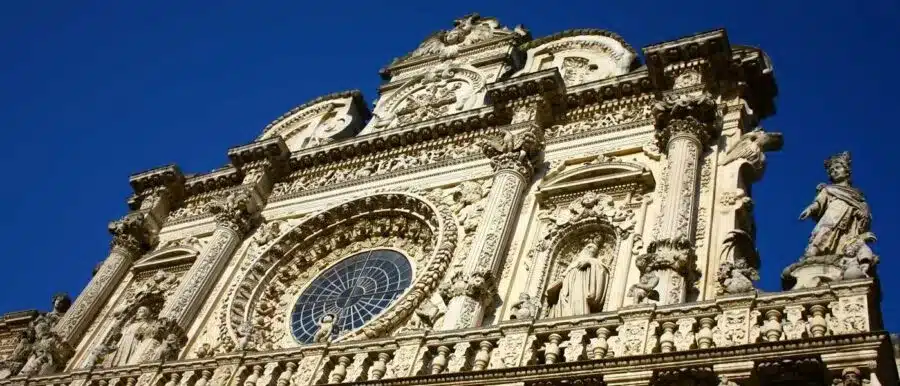
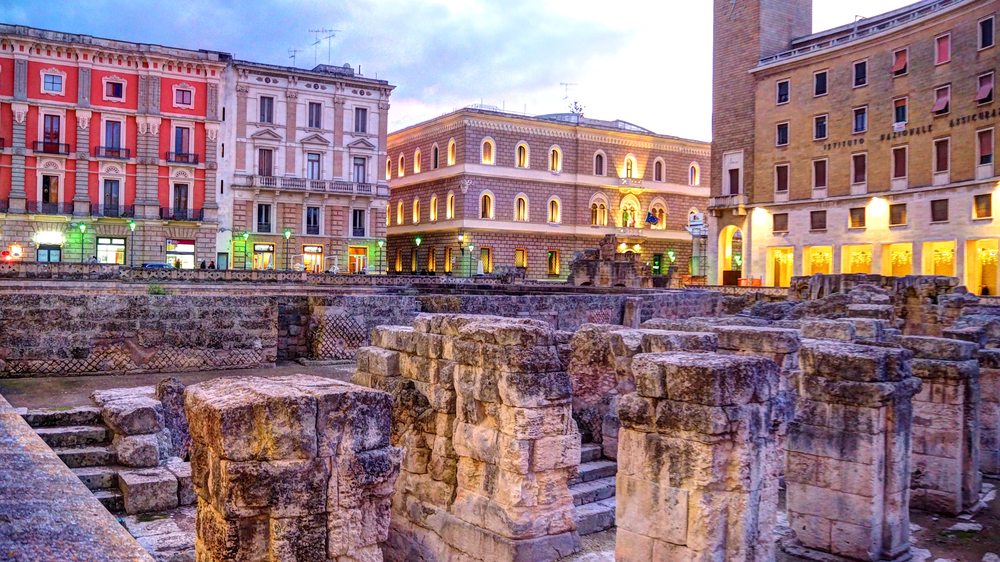
Lecce earns its reputation as the Florence of the Baroque without exaggeration. The historic centre is built almost entirely from pietra leccese — local golden limestone soft enough to carve like wood — and the 17th-century architects exploited this property to its absolute maximum. The Basilica di Santa Croce took 150 years and four architects to complete and is still the most ornately carved church facade in southern Italy. The main piazza has a 2nd-century Roman amphitheatre excavated in its centre. The pasticciotto — short-crust pastry filled with warm custard cream — is the breakfast Salento invented and perfected.
Lecce is also the best base for exploring the rest of Salento. Almost every town on this list is within an hour by car. See our complete Lecce guide for everything you need.
Otranto – Italy’s Eastern Edge
Otranto is the easternmost point of mainland Italy — the place where the country ends and the Adriatic begins, with the Albanian coast visible on the horizon on clear days. The walled old town has two defining attractions: the 12th-century cathedral with a mosaic floor covering the entire nave (one of the finest examples of medieval art in southern Italy), and the Chapel of the Martyrs, where the bones of 800 residents executed by Ottoman forces in 1480 still rest in glass cases along the walls. The Aragonese Castle above the harbour completes the picture. The beaches nearby — particularly Baia dei Turchi — are among the best on the Adriatic coast.

⭐ Book tours & experiences
Visit Get Your Guide or Viator for unforgettable activities, skip-the-line tickets, and local adventures.
✔ Instant confirmation
✔ Small groups
Gallipoli – The Pearl of the Ionian
Gallipoli’s old town occupies a small island connected to the mainland by a 17th-century bridge, its whitewashed lanes and baroque churches ringed on three sides by the Ionian Sea. The fish market at the base of the island walls opens before dawn — one of the most atmospheric markets in Puglia. The Aragonese castle guards the bridge entrance. The Ionian beaches south of the town (Baia Verde, Punta della Suina) are among the finest in Salento. And Gallipoli has the best nightlife in the entire region — the beach clubs at Baia Verde transition into clubs from early evening and the old town bars stay open until late.

Santa Maria di Leuca
Situated at the southernmost tip of the Salento peninsula, Santa Maria di Leuca offers breathtaking coastal views and a serene atmosphere. Climb to the top of the towering Lighthouse for panoramic vistas, or relax on the pristine beaches nestled along the rugged coastline.

⭐ Top-Rated Food Experience in Puglia
Discover authentic frisella, local markets, and hidden bakeries with a local guide. Perfect for first-time visitors.
✔ Instant confirmation
✔ Small groups
Galatina
Galatina is famous for its stunning Basilica of Saint Catherine, adorned with breathtaking frescoes and intricate stone carvings. Galatina is also known as the historical birthplace of the pasticciotto — the short-crust custard pastry now ubiquitous across Salento — though Lecce has long since claimed it as its own.

Tricase
Nestled amidst olive groves and vineyards, Tricase exudes rustic charm and tranquility. Explore the town’s historic center with its ancient palaces and churches, or venture into the surrounding countryside for scenic hikes and picnics amidst nature.
While Tricase is not directly on the coast, it is relatively close to several beaches along the Adriatic Sea. Some of the nearby beaches include Marina di Tricase, Marina Serra, and Porto Badisco.

Martano
Martano is a hidden gem nestled in the heart of the Salento countryside. Discover the town’s rich agricultural heritage at the weekly market, where you can sample locally grown produce and traditional delicacies. Martano was previously surrounded by formidable fortifications erected by its rulers to shield it from Turkish invasions.
As time progressed, Martano underwent a metamorphosis from a fortified stronghold to a hospitable village. The defensive walls have disappeared, and instead, visitors are encouraged to explore its enchanting streets and alleys, marveling at the splendor of its historical palaces and Baroque churches.
Acaya
Nestled in the countryside near Lecce, Acaya is a hidden gem known for its well-preserved fortress and tranquil surroundings. It is situated near the Adriatic Sea, just a few kilometers northeast of Lecce, the regional capital. Acaya is known for its historical significance and its well-preserved fortress. The main attraction in Acaya is the Castle. This fortress was built in the 16th century as a defensive stronghold against attacks from the Ottoman Empire.

Castro
Perched atop dramatic limestone cliffs overlooking the Adriatic Sea, Castro offers stunning coastal views and a rich maritime history. Explore the town’s ancient Castro Castle, dating back to the 12th century, and take a refreshing dip in the crystal-clear waters of the nearby Zinzulusa Cave. For more information check the tourist office website

Nardó
Nardò boasts a rich tapestry of history, culture, and stunning architecture. Explore the town’s well-preserved Baroque buildings and elegant piazzas, including the magnificent Palazzo del Municipio and the imposing Cathedral of Santa Maria Assunta. Wander through the charming historic center, lined with artisan workshops and traditional cafes, and immerse yourself in the vibrant atmosphere of this enchanting Salento gem.

Presicce
Presicce is a picturesque village known for its well-preserved historic center and unique underground oil mills, carved into the limestone rock. Explore the narrow cobblestone streets lined with charming whitewashed houses adorned with colorful flowers. Visit the Church of San Giovanni Battista, with its stunning Baroque architecture, and don’t miss the opportunity to explore the fascinating underground world of the town’s ancient oil mills. Presicce offers a delightful blend of history, culture, and natural beauty, making it a must-visit destination in Salento.


Salento rewards the visitor who moves slowly and stays curious. The towns on this list are each worth a minimum of half a day — some, like Lecce and Otranto, deserve two nights. The distances between them are short enough that combining three or four in a single itinerary is entirely realistic with a car.
For the full picture of what Salento offers — beaches, food, getting there, where to stay — see our Salento travel guide. And if you want a ready-made route through the region, our Puglia itinerary covers the whole drive from north to south.
❓ Frequently Asked Questions
The standout towns in Salento are Lecce (the baroque capital and best overall base), Otranto (the walled Adriatic city with the extraordinary cathedral mosaic), Gallipoli (the island old town on the Ionian with excellent beaches and nightlife), Galatina (the Basilica of Santa Caterina d’Alessandria with its 14th-century frescoes), and Castro (the clifftop village above the Zinzulusa sea cave). Santa Maria di Leuca at the very tip of Italy and Presicce with its underground oil mills round out the most compelling options.
Yes — it’s one of the most rewarding regions in southern Italy and consistently underrated compared to Tuscany or the Amalfi Coast. The combination of extraordinary baroque cities, two contrasting coastlines (the rocky Adriatic and the sandy Ionian), exceptional food and wine, and a pace of life that is genuinely unhurried makes Salento one of the best all-round travel destinations in Italy. Outside July and August the crowds are minimal and the prices are significantly lower than more famous Italian destinations.
Five to seven days allows you to cover the main highlights comfortably — two nights in Lecce (with day trips to Otranto and Gallipoli), a beach day on the Ionian coast, and time for the smaller towns like Galatina, Castro, and Presicce. Ten days gives you the full picture at a relaxed pace. A long weekend (three to four days) is enough for Lecce and two or three day trips.
Salento is known for its baroque architecture (particularly in Lecce), its two contrasting coastlines (the dramatic rocky Adriatic and the long sandy Ionian), its food (pasticciotto pastry, raw seafood, orecchiette pasta, burrata), its Negroamaro and Primitivo wines, the traditional pizzica music and dance, and the Notte della Taranta festival in August. It is the southernmost part of Puglia — the heel of Italy’s boot — and one of the most popular domestic holiday destinations for Italians.


