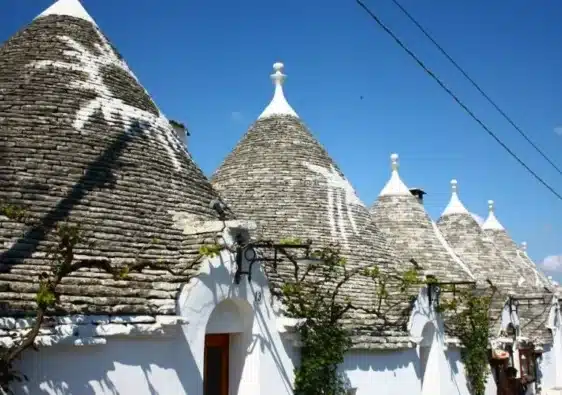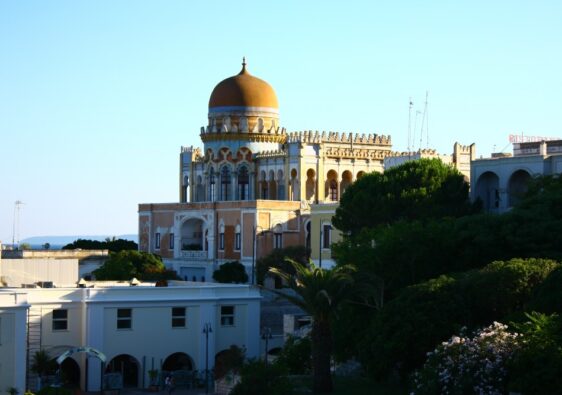

Most people who pass through San Vito dei Normanni are on their way somewhere else — to the white alleys of Ostuni, the beaches of Torre Guaceto, or the trulli further into the Valle d’Itria. That’s a shame, because this flat, sun-baked little town in the province of Brindisi has a genuinely layered history packed into a compact, unpretentious center — a Norman castle still standing at the heart of its main square, Byzantine hermit caves hidden in the countryside, and a native grape variety that almost disappeared entirely before a handful of local winemakers brought it back.
San Vito’s story starts earlier than its current name suggests. The settlement was first established around 963 AD by Slavic refugees fleeing Saracen raids along the Dalmatian coast, and for most of its history it was known as San Vito degli Schiavoni — “of the Slavs.” It wasn’t until 1863, after Italian unification, that the town was renamed in honor of the Norman knight Bohemond of Hauteville, son of Robert Guiscard, tying the town’s identity to the Norman conquest of southern Italy rather than its original Slavic founders. That layering — Slavic origins, Norman rebranding, centuries of Byzantine religious life folded in between — is still visible if you know where to look, and it’s exactly what makes San Vito worth a stop rather than a drive-by. Keep reading and you’ll have everything you need: what to see, when to visit, and how it fits into a wider Salento itinerary.

🏰 Castello Dentice di Frasso: The Town’s Anchor
Nothing in San Vito competes with the Castello Dentice di Frasso for attention. It dominates Piazza Leonardo Leo, the town’s main square, exactly as it has for roughly a thousand years — the core of the structure is a Norman-era square tower dating back to the 11th century, around which later noble families, the Dentice di Frasso among them, built out a Renaissance-style residence with a courtyard and a set of decorated reception rooms. Unlike some of Puglia’s more heavily restored castles, this one still reads as a working seat of local power rather than a museum piece, since the historic center quite literally organizes itself around it — streets, shops and the daily rhythm of the piazza all orbit the castle’s walls.
💡 Pro tip: San Vito’s castle shares its surname — Dentice di Frasso — with the castle in nearby Carovigno, since the same noble family held both. If you’re visiting both towns on the same trip, it’s a nice thread to follow between the two.

⛪ Basilica di Santa Maria della Vittoria
A short walk from the castle, the Basilica di Santa Maria della Vittoria is the town’s most important religious building — elevated to the rank of minor papal basilica in 1998, a distinction that puts it in fairly select company among Puglia’s churches. It anchors the square alongside the castle and the nearby Chiesa di San Giovanni Evangelista, a Baroque church that rounds out the historic center’s main religious landmarks. Together, the two churches and the castle make for an easy, flat half-hour loop through the oldest part of town — genuinely walkable in a way that some of Puglia’s steeper hill towns aren’t.
🕳️ The Rock Crypt of San Biagio
The most unexpected thing to see near San Vito isn’t in the town at all — it’s a few kilometres out into the countryside, in the Jannuzzo district toward Brindisi. The Cripta di San Biagio is a Byzantine-era rock church cut into a small rupestrian settlement, with a documented consecration date of 8 October 1196 and a fresco cycle that’s considered unique in all of Southern Italy. The crypt was originally built with two entrances and a carved iconostasis dividing the nave from the altar area, though an 18th-century restructuring removed the screen and shifted the altar further east — a reminder that even a site this old has its own layered restoration history. Two smaller adjoining caves, likely a refectory and a hermit’s cell, complete the small rupestrian complex around it.
Visits run by reservation only, with guided tours generally available around midday, and entry is capped to protect the frescoes — so this isn’t a stop you can simply drop in on unannounced. It’s a genuinely striking contrast with the Castle and the Basilica back in town, and worth the detour if rupestrian churches or medieval frescoes interest you at all.
💡 Pro tip: book your Cripta di San Biagio visit by phone or email a few days ahead rather than on the day — entry numbers are deliberately limited, and showing up without a reservation is the most common way visitors miss it entirely.

🏺 Castello d’Alceste and the Messapian Past
Long before the Normans or the Slavic settlers who preceded them, this stretch of Brindisi province was Messapian territory — part of the pre-Roman civilization that once controlled much of the Salento peninsula. On the edge of San Vito’s modern urban area, the site known locally as Castello d’Alceste preserves traces of that much older settlement, a quieter counterpart to the better-known Messapian ruins at nearby Ceglie Messapica. It’s not a polished, ticketed archaeological park in the way some Puglia sites are, and that’s part of its appeal if you’re the kind of traveler who likes finding the older layers of a place without a gift shop attached — a short stop for anyone building a fuller picture of how many civilizations have actually passed through this small corner of the heel of Italy.
🌳 Piazza Leonardo Leo and the Villa Comunale
Once you’ve seen the castle and the two main churches, the rest of San Vito’s center rewards simply slowing down. Piazza Leonardo Leo is the square where all of it meets — named for the 18th-century Neapolitan composer born in the town, whose music is still celebrated locally — and it’s genuinely the best vantage point for understanding how compactly San Vito is built around its castle. A few streets over, the Villa Comunale, the town’s public garden, offers a shadier, more everyday counterpoint: locals walking dogs, kids on bikes, retirees on benches rather than tour groups with cameras. It’s a small thing, but it’s exactly the kind of ordinary, lived-in moment that’s easy to miss in Puglia’s more photographed towns, where every street can start to feel staged for visitors rather than lived in by residents.
💡 Pro tip: if you want a genuine sense of daily life in a Puglia town that hasn’t been reshaped around tourism, give yourself twenty unstructured minutes in the Villa Comunale rather than rushing straight from the castle to the car — it’s a small contrast worth experiencing after towns like Ostuni that see far heavier visitor numbers.

🍝 What to Eat in San Vito dei Normanni
San Vito’s kitchen follows the same inland Brindisi-province logic as its neighbors: simple, vegetable- and legume-forward cooking built around whatever the surrounding olive groves and fields produce, rather than the seafood-heavy menus you’d find on the coast just a few kilometres away. Look for orecchiette or other fresh pasta shapes tossed with turnip greens (cime di rapa) or a light tomato sauce, fave e cicorie (fava bean purée with wild chicory), and grilled or baked vegetables dressed simply in the region’s excellent olive oil. Bread and focaccia from a good local forno are worth seeking out too — this part of Brindisi province takes its bread baking seriously, and a still-warm slice from a bakery near the main square makes a better mid-morning stop than most tourist-facing cafés would offer.
⭐ Top-Rated Food Experience in Puglia
Discover authentic frisella, local markets, and hidden bakeries with a local guide. Perfect for first-time visitors.
✔ Instant confirmation
✔ Small groups
🍷 Ottavianello: San Vito’s Own Wine
If there’s one thing locals here will insist you try, it’s Ottavianello — a black-skinned grape variety that has effectively become San Vito dei Normanni’s own. The vine likely takes its name from Ottaviano, near Naples, and arrived in the Brindisi area in the late 1800s by way of the Marquis of Bugnano, taking root around San Vito specifically rather than spreading evenly across the wider region. For decades it was mostly blended away into other wines, usually alongside Negroamaro, and came close to disappearing as a variety in its own right. A handful of local producers have since revived it as a standalone bottling — a deep ruby wine that mellows toward garnet with age, carrying red fruit, rose petal and violet notes alongside a light herbaceous edge and soft, well-integrated tannins. It’s an easy match for eggplant parmigiana, fresh pasta in a light tomato sauce, or a plate of aged local cheese — in other words, exactly the kind of meal you’re likely to be eating anyway on a stop through this part of Brindisi province.
💡 Pro tip: Ottavianello rarely travels far outside its home territory, so a bottle picked up locally in San Vito or a nearby enoteca is a genuinely distinctive souvenir — one you’re unlikely to find easily once you’re back home.
🗓️ Best Time to Visit San Vito dei Normanni
| Season | What to expect |
|---|---|
| Spring (Apr–May) | Mild, green countryside, comfortable for walking the center and visiting the crypt |
| Early Summer (Jun) | Warm but not yet peak heat, good balance before the coast gets busy |
| Peak Summer (Jul–Aug) | Hot and dry (average August temperatures around 25°C, often higher at midday); best used as an inland stop on the way to or from the coast |
| September | Warm, quieter, grape harvest season — a good time to catch Ottavianello at its freshest |
| Winter (Oct–Mar) | Quiet and mild (averaging around 9–10°C), with the castle and crypt both easiest to visit without crowds |
💡 Pro tip: San Vito sits on flat, open terrain with very little shade in its historic center, so if you’re visiting in July or August, plan your walk through the piazza and churches for the morning and save the afternoon for the coast or a shaded masseria stop instead.
🚗 How to Get to San Vito dei Normanni
San Vito sits inland in Brindisi province, about 9 kilometres from the Adriatic coast and the Torre Guaceto reserve. The nearest airport is Brindisi Salento Airport, roughly 20–25 minutes away by car, making this one of the more conveniently placed stops in this guide if you’re flying directly into the region. Bari Karol Wojtyła is a further option, at around an hour and a half by car.
⭐ Rent Your Car
Search rental deals with Rentalcars — easy and hassle-free.
✔ Instant confirmation
A car is the practical way to get here and to combine San Vito with the surrounding towns — public transport exists between the larger centers in Brindisi province, but a rental car gives you the flexibility to add the Cripta di San Biagio and a coastal stop at Torre Guaceto onto the same day without working around bus timetables.
🗺️ Nearby Places Worth Visiting
- Ostuni — the famous “White City,” roughly 20 minutes away, an easy pairing for the same day
- Carovigno — another Dentice di Frasso castle town, a short drive northeast
- Torre Guaceto — one of Puglia’s best-protected stretches of coastline, about 9km away and the natural beach stop after an inland morning
- Ceglie Messapica — further into the Valle d’Itria, well known for its own food scene
- Mesagne and Brindisi — both within easy reach if you’re basing yourself in the provincial capital
Plan Your Visit to San Vito dei Normanni
San Vito dei Normanni isn’t going to be the single headline stop on anyone’s Puglia itinerary, and it doesn’t need to be — its appeal is exactly in how unforced it feels. A castle that still anchors daily life rather than just a ticket queue, a Byzantine crypt that takes an actual reservation to see rather than a crowd to fight through, and a wine that almost nobody outside the province has heard of. Build it in as a half-day between Ostuni and the coast, or as the quiet counterpoint to a trip otherwise spent in Puglia’s bigger-name towns.
Sort your car rental, book the crypt visit ahead if that’s part of your plan, and leave room on the table for a glass of Ottavianello with dinner. For more of this corner of Brindisi province, our guides to Ostuni and Torre Guaceto go deeper into the two most obvious pairings.
✅ Book your flights: Find the best airfare deals with Skyscanner or Aviasales.
🏨 Secure your stay: Compare hotel rates easily on Booking.com or Hotellook.
🛡️ Don’t forget travel insurance: Stay protected with Ekta or VisitorsCoverage — reliable and flexible options.
🎟️ Book tours & experiences: I always use Get Your Guide or Viator for unforgettable activities, skip-the-line tickets, and local adventures.
🚗 Need a car? Search rental deals with Rentalcars and DiscoverCars — easy and hassle-free.
🚕 Taxi or transfer? Pre-book your ride with WelcomePickups or GetTransfer for a smooth arrival.
🚆 Traveling by train or bus? Check schedules and book tickets in advance with Omio.
FAQs
Yes, especially as a half-day stop alongside Ostuni or Torre Guaceto — it has a genuine Norman-era castle, a rare Byzantine rock crypt with 12th-century frescoes, and a native wine variety found almost nowhere else.
The town was originally founded by Slavic refugees around 963 AD and known as San Vito degli Schiavoni. It was renamed in 1863, after Italian unification, in honor of the Norman knight Bohemond of Hauteville.
By reservation only — contact the local tourist office ahead of time, since entry is limited to protect the 12th-century frescoes inside. Guided tours typically run around midday.
Ottavianello, a black-skinned grape variety historically associated specifically with this town, now increasingly bottled as a standalone wine after decades of mostly being blended into other reds.
About 9 kilometres from Torre Guaceto, making it an easy inland-and-coast combination for a single day.